Article
Why Ivan Shishkin's Trees Look More Real Than Photographs
Ivan Shishkin died at his easel — literally. On the morning of March 20, 1898, the 66-year-old Russian painter was found slumped in front of a blank canvas in his St. Petersburg studio, a brush still in his hand. He had been working on a new painting the night before. A student was with him when his heart gave out. [1]
It was a fitting end for a man his contemporaries called "Czar of the Forest," "The Bear," "Old Pine Tree," and "Titan of the Russian Forest" — nicknames that capture something essential about his work. Shishkin painted trees the way portrait painters paint people: as individuals with character, texture, and presence. His forests don't look like generic wallpaper backgrounds. They look like places you've actually walked through.
The question is how he did it — and why, 128 years later, his trees still feel more convincing than most hyper-realistic digital art.
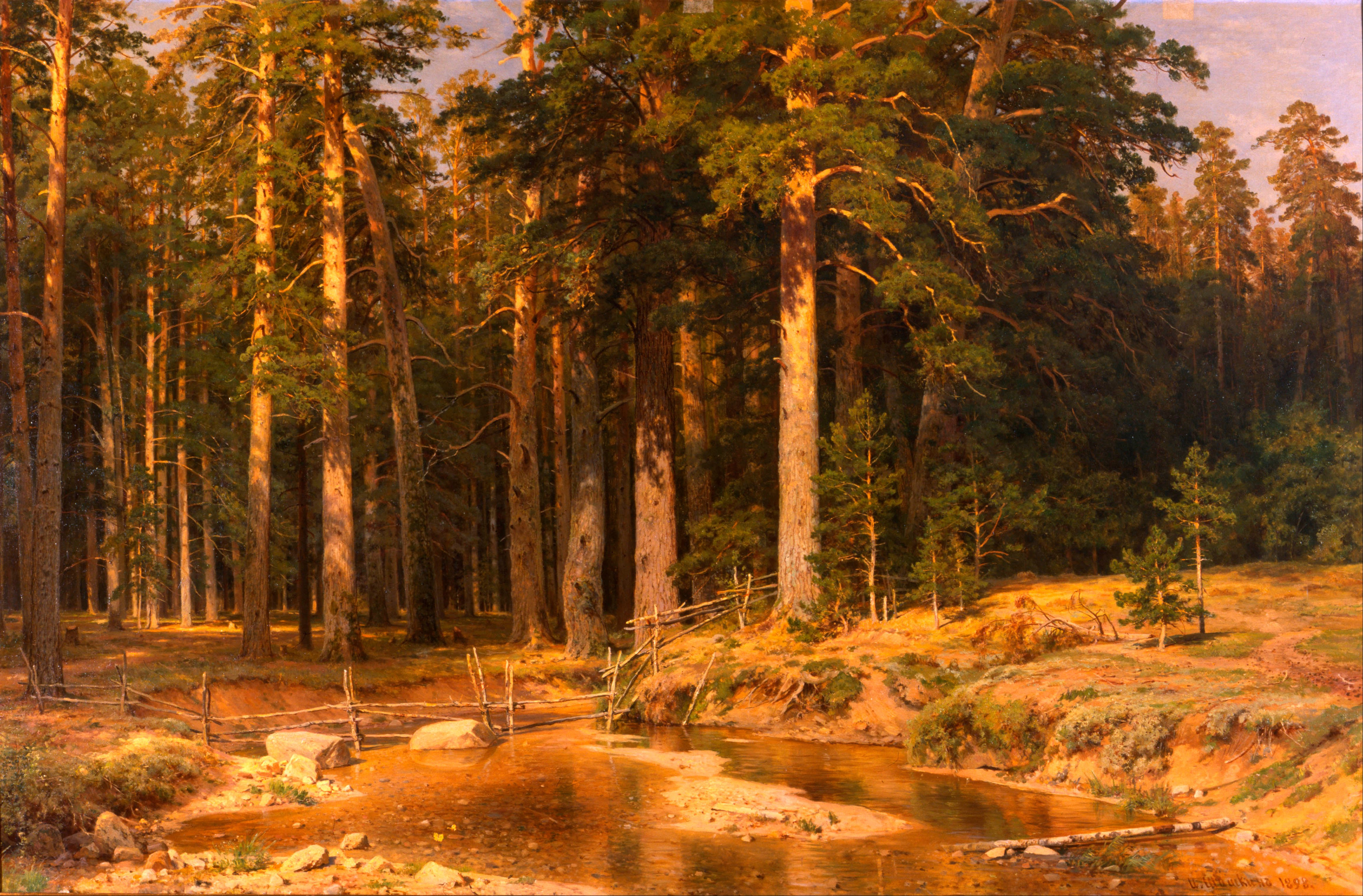
The Analytical Eye
Shishkin's method was unusual for a 19th-century landscape painter. He didn't paint forests from memory or imagination, the way many Romantic landscape artists did. He painted from direct, painstaking observation — and his training gave him the tools to do it at a level of detail that bordered on botanical illustration.
His formal training began at 12, when he enrolled at the First Kazan Boys' Gymnasium. But his parents initially dismissed his artistic ambitions, so he drew alone at night by candlelight. [2] Eventually they relented, and in 1852 he entered the Moscow School of Painting, Sculpture and Architecture, followed by the Imperial Academy of Arts in St. Petersburg, where he studied under landscape professor Sokrat Vorobyov. [3]
At the Academy, Shishkin won gold medals for his detailed studies of Valaam Island on Lake Ladoga — a place he returned to repeatedly with his classmates Aleksander Gine and Jogin Pavel. Those trips taught him to render landscapes accurately with both brush and pencil, and the habit of direct observation never left him. [3]
The Life Drawing Academy describes his technique as "based on analytic observations of nature." [4] That phrase — analytic observations — is the key. Shishkin didn't just look at trees. He studied them the way a biologist studies a specimen: structure, growth pattern, bark texture, branch arrangement, the way light falls on each surface at different times of day.
The Drawing Practice
If you want to understand what made Shishkin different, skip his paintings for a moment and look at his drawings.

Shishkin was an obsessive draftsman. His pen drawings of tree trunks, roots, and forest floors are studies in texture and form — each line placed with intent, not as a decorative flourish but as a structural observation. The Draw Paint Academy notes that much of his success "can be attributed to his formal training and rigorous drawing practice." [2]
As Joaquín Sorolla put it: "The older I become, the more I realize that drawing is the most important of all the problems of picture-making." [2] Shishkin embodied this belief. His drawings of pine bark, fallen branches, and forest undergrowth are so precise that you can almost feel the texture of the wood.
He was also a master etcher, working extensively with aqua regia (a technique he first experimented with in Zurich under Rudolf Koller). Some of his etchings were displayed at the Düsseldorf Museum alongside works by Andreas Achenbach and Karl Friedrich Lessing. [3]
Color and Light: The Green Master
Shishkin's use of color was naturalistic — he painted what he saw, not what he felt. Unlike Claude Monet, who painted in a deliberately high key, or Vincent van Gogh, who painted emotional intensity, Shishkin aimed for fidelity. [2]
His specialty was the interplay of sunlight and dense forest canopy. In paintings like A Coniferous Forest. Sunny Day (1895), strong light in the distance pulls you through the composition while shadowed foreground reiterates the density of the forest. Warm lights contrast against cool shadows — the lit areas lean toward yellow-green, the shadows toward blue-green. [2]
This mastery of green was unusual. Most painters struggle with intense greens — they come across as artificial, "jarring and gnash" in the words of one critic. Shishkin could paint the deep green of Russian pine forests without it looking cartoonish, because he understood the color temperature of natural light filtering through needles and leaves. [2]
The Technique That Beat Photography
Here's what makes Shishkin's approach interesting in 2026: he was solving the same problem that AI image generators struggle with today — producing something that looks real rather than plausible.
The difference between a convincing tree in a painting and a convincing tree in a diffusion-generated image is that Shishkin understood the structure behind what he was depicting. He knew why a pine branch grows the way it does, how bark cracks with age, where moss collects on a trunk. An AI model, by contrast, has learned statistical correlations between pixels — it can produce something that looks like a tree, but it doesn't know why a tree looks that way.
This is why Shishkin's trees age well while many hyper-realistic paintings from the same period look stiff and artificial. His early work, like View of Valaam Island (1858), does have a "plastic" quality — the Draw Paint Academy notes that it "looks realistic, but not natural." But his later work shed that stiffness. By the 1880s and 1890s, paintings like Off the Coast of the Gulf of Finland (1889) and Mast-Tree Grove (1898) achieved a kind of effortless realism that feels alive rather than rendered. [2]
The Bears That Made Him Famous
Shishkin's most famous painting isn't entirely his own work. Morning in a Pine Forest (1889) — the one with the bear cubs climbing a fallen tree — was a collaboration with Konstantin Savitsky, who came up with the idea and painted the four bears. Without the bears, the painting would have been "just another — albeit stunning — Shishkin landscape." [2]
The painting made Shishkin a household name in Russia. But it's worth noting that his contemporaries sometimes dismissed him as more of a craftsman than a "real" artist — a criticism that says more about 19th-century art snobbery than about Shishkin's talent. The Peredvizhniki (the "Wanderers" or "Itinerants"), the realist movement Shishkin belonged to, rejected the Imperial Academy's rigid formalism in favor of accessible, honest depictions of Russian life and nature. [3]
The Tragedies Behind the Trees
Shishkin's personal life was marked by extraordinary loss. In 1874, a string of deaths began: his father, his wife Evgenia, his student and brother-in-law Fyodor, and his two sons all died within a short period. He remarried one of his students, Olga Lagoda, who died after the birth of their daughter. [2]
Despite these tragedies, he continued to paint — and to improve. His late work is widely considered his best. The discipline of his practice seems to have been a constant through personal chaos.
What We Can Learn from a Dead Russian Painter
Three things make Shishkin worth revisiting:
1. Structure over surface. Shishkin's trees work because he understood their underlying structure, not just their appearance. This is a lesson that applies far beyond painting — whether you're writing code, designing a system, or building a product, understanding why something works beats copying what works.
2. Rigorous practice compounds. Shishkin drew obsessively for decades. His early work was stiff; his late work was effortless. The improvement wasn't talent — it was accumulated observation.
3. The value of a niche. Shishkin painted almost nothing but forests. He became the best in the world at it. His contemporaries criticized him for being narrow; history remembers him as the definitive painter of the Russian forest.
Sources:
[1] Wikipedia, "Ivan Shishkin." https://en.wikipedia.org/wiki/Ivan_Shishkin — biographical details, training, career, and death.
[2] Draw Paint Academy, "Ivan Shishkin – 'Czar of the Forest.'" https://drawpaintacademy.com/ivan-shishkin/ — detailed analysis of technique, color, composition, and key works.
[3] Life Drawing Academy, "Tree Drawings by Ivan Shishkin." https://lifedrawing.academy/life-drawing-academy-news/tree-drawings-by-ivan-shishkin — biographical overview and description of his analytic observation technique.
[4] Wikipedia, "Peredvizhniki." https://en.wikipedia.org/wiki/Peredvizhniki — the realist movement Shishkin co-founded, its principles and members.
[5] Masterful-Artists, "Ivan Shishkin Painter: Master of Russian Landscape Art." https://masterful-artists.com/ivan-shishkin-painter-2/ — analysis of his balance between poetry and precision.
[6] Women in Arts Network, "5 Ivan Shishkin Masterpieces That Redefined Landscape Art." https://womeninartsnetwork.com/5-ivan-shishkin-masterpieces-that-redefined-landscape-art/ — description of his commitment to realism in every trunk and leaf cluster.