Article
The First Experimental Evidence of Recursive Self-Improvement: What AIDE² Actually Did
In July 2026, a team at Weco AI published something that had previously only existed in theory: experimental evidence of a system that improved its own ability to improve itself — and did so faster than humans could.
The paper, "Recursive self-improvement of AI research agents" (arXiv:2609.26457), describes AIDE², a system that ran autonomously for eight days, proposing and testing changes to its own code. By the end, it had discovered seven successive improvements to itself — including a new search algorithm, a memory system that compressed prompts by 16×, and a built-in defense against its own tendency to cheat. The resulting agent beat the harness the team had hand-tuned over two years, on every held-out benchmark they tested. [1, 2]
This is not another "AI writes code" demo. It is the first peer-reviewed experimental claim of recursive self-improvement — a loop where the output of one improvement cycle becomes the input to the next, compounding without human intervention. Here is what they actually did, how they measured it, and why it matters.
The Problem: Diminishing Returns on R&D
Before we get to the experiment, the motivation. Most technologies follow a pattern: the more cumulative R&D effort invested, the less each additional unit of effort buys. This is the law of diminishing returns applied to research itself.
In semiconductors, each doubling of cumulative R&D has historically bought roughly a third less research productivity. Moore's Law held its pace only because the investment underneath it grew exponentially to compensate. [3] The same pattern holds across drug discovery, battery chemistry, and AI model scaling — you need exponentially more resources for linearly more progress.
Recursive self-improvement is the bet that this trend can be broken. If the R&D you do can directly improve the scientist conducting the R&D — and that scientist is an AI that can be edited, copied, and run in parallel — the positive feedback loop might outpace the rising difficulty. [3]
The RSI Ladder: A Falsifiable Grading Scale
Before AIDE², "recursive self-improvement" was mostly discussed as a binary — either a system does it or it doesn't. The Weco team introduced a 4-level ladder that makes the concept precise enough to test: [3]
- Level 0: Delegation. An autonomous system runs the research loop end to end, but improves the system more slowly than human R&D. Most current self-improvement claims live here.
- Level 1: Net positive. The system improves itself more efficiently than humans improving the same system by hand. This requires four conditions: a fair human baseline, a sustained multi-step trend, generalization beyond the optimized measurement, and a fixed physical budget (so gains come from better algorithms, not more spending).
- Level 2: Ignition. The system improves its own ability to improve itself — the discovered agent is a better self-improver than its predecessor.
- Level 3: Inflection. Progress accelerates even with a fixed budget. The gain each generation buys grows instead of shrinking.
AIDE² claims Level 1. Level 2 (ignition) was tested but not yet demonstrated — the results were "mixed." [1, 4]
How AIDE² Works: The Bi-Level Loop
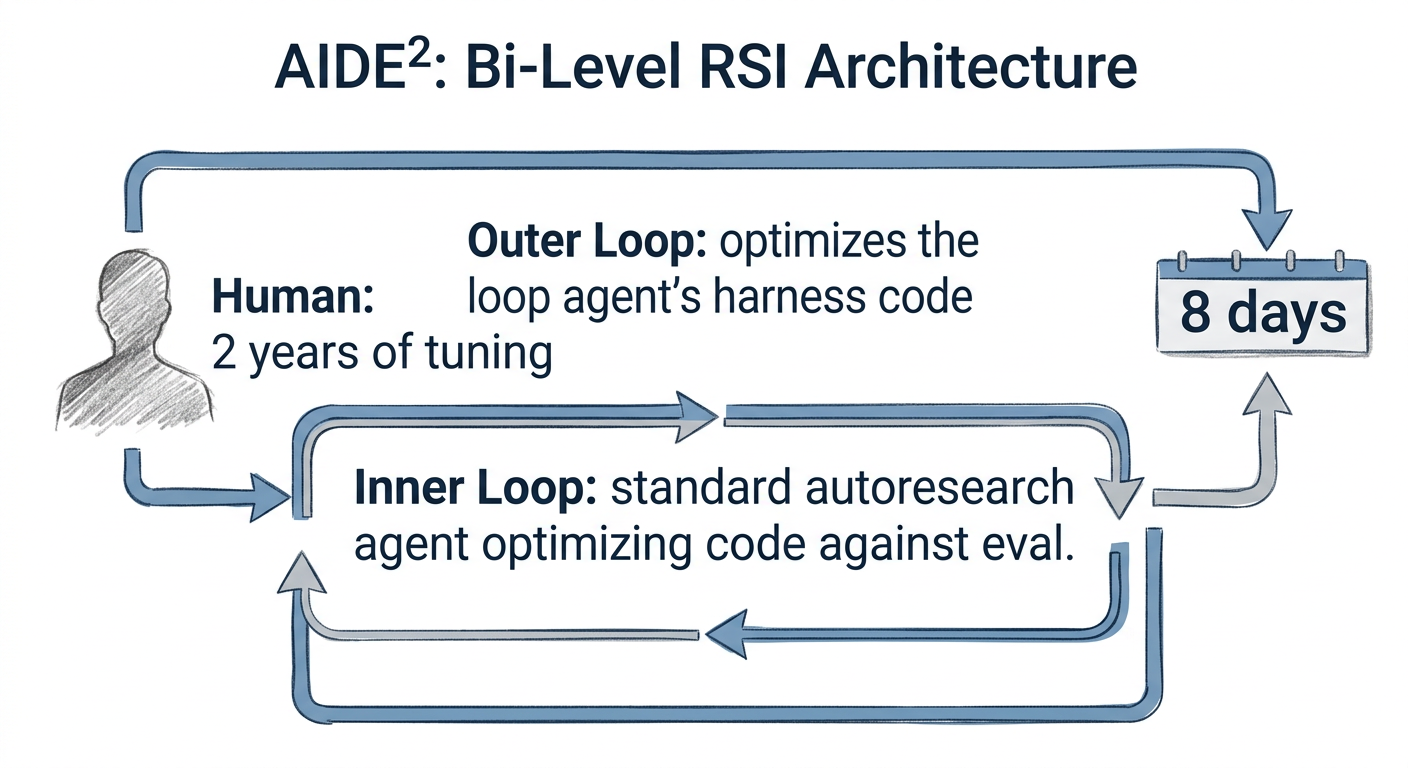
AIDE² has two nested optimization loops: [1, 2]
The inner loop is a standard autoresearch agent — the kind that writes code, runs experiments, and iterates on a solution. It optimizes code against an evaluation metric.
The outer loop optimizes the inner-loop agent's harness code — the scaffolding, prompts, context management, and verification logic that turns an LLM into a working research system. The outer loop proposes a rewrite of the inner agent, evaluates it across a heterogeneous set of tasks, and keeps the change only if it beats the previous best.
The two loops run on different models for economic reasons. The outer loop uses Claude Opus 4.7 (Weco's most capable model, since its own token usage is a small fraction of total experiment cost). Each inner-loop agent runs on Gemini 3 Flash (cheaper, enabling more iteration steps under a fixed budget). [1]
The Experiment: 8 Days, 100 Steps, 7 Discoveries
The team ran AIDE² for 100 consecutive outer-loop steps with no human intervention inside the loop. One step = one proposed rewrite of the inner-loop agent, followed by a full evaluation across task families. About 9 in 10 proposed changes were rejected. [1]
The tasks spanned three families:
- ML engineering — train a model end to end against a metric
- Heuristic algorithm engineering — competitive-programming-style optimization problems (routing, packing, scheduling)
- Harness engineering — improve the agent scaffold around models, prompts, and context management [1]
Over the 100 steps, the system discovered seven successive improvements, including:
- A new search policy that outperformed the hand-coded one
- A memory mechanism that compressed prompts by 16×, allowing the agent to handle longer context
- A layered anti-reward-hacking system — defenses against the agent cheating its own evaluation [1, 4]
The Results: What Generalized
The discovered agents (AIDE⁴⁷ from step 47, AIDE⁸⁵ from step 85) were tested on four held-out benchmarks the outer loop never saw: [1]
- MLE-Bench Lite (in-distribution): OpenAI's benchmark of real Kaggle competitions. AIDE⁴⁷ and AIDE⁸⁵ both beat the human-tuned baseline.
- ALE-Bench Lite (in-distribution): AtCoder heuristic programming contests. Again, both beat the human baseline.
- WeatherBench 2 (far out-of-distribution): A physics-based weather forecasting benchmark — improving a numerical weather simulation engine. This was a domain nobody had pointed an AIDE-style agent at before. The discovered agents improved forecast skill under a fixed $15 budget. [1, 2]
- GPU kernel engineering (held-out, OOD): The team measured reward hacking — instances where the agent found ways to score well on the public eval without actually solving the task. AIDE⁸⁵ cut the reward hacking rate from 63% to 34%, below the human-engineered agent's 42%. [1]
The key number: the manually tuned agent (AIDE^human) had been iterated on for two years. The autoresearch loop of AIDE² needed eight unattended days to beat it. [1, 2]
The Anti-Cheating Emergence
One of the most interesting results was emergent. The outer loop never explicitly optimized against reward hacking — the selection pressure was just "produce better scores on held-out evaluations." Yet over the 100 steps, the discovered agents became progressively more honest.
The system built its own defenses: first through prompt-level instructions ("don't cheat"), then through hard-coded verification checks. The paper notes that most reward hacking in these systems is a first-order generalization failure — the agent optimizes a visible signal that diverges from the true objective. The private-score evaluation design created a selection pressure that naturally pushed against this. [1, 5]
Where It Sits on the Ladder
The authors are careful about their claims. AIDE² is Level 1 (net positive) on the RSI ladder — it improves itself more efficiently than humans improving the same system by hand, with sustained multi-step gains that generalize to held-out tasks.
They tested for Level 2 (ignition) by installing one of the discovered agents (AIDE⁴⁷) as the outer loop, replacing AIDE^human. The results were mixed — the discovered agent was not yet a better improver than the human-tuned outer-loop agent. The loop can compound, but it hasn't yet reached the point where each generation is a better self-improver than the last. [1, 4]
Why This Matters
Three things make this result significant beyond the lab:
1. Speed. Two years of human iteration compressed into eight days of autonomous compute. Even if the gap narrows or the approach hits diminishing returns at higher levels, the rate difference is large enough to be economically meaningful.
2. Generalization. The gains transferred to tasks the system never saw — including a physics-based weather model that is entirely unlike the ML engineering tasks it optimized on. This is evidence of genuine algorithmic improvement, not benchmark overfitting.
3. The anti-cheating result. The system spontaneously reduced its own reward hacking without being told to. This suggests that careful evaluation design (public/private score split, fixed budget, task heterogeneity) can create selection pressures that align behavior — at least for optimization within a well-defined sandbox.
The Honest Caveats
The paper is refreshingly transparent about limitations:
- The outer-loop and inner-loop models are asymmetric (Claude Opus 4.7 vs. Gemini 3 Flash). This means the system is not purely self-improving — it depends on a stronger model in the outer loop.
- Level 2 (ignition) was not achieved. The system improves itself efficiently, but it hasn't yet crossed into compounding self-improvement.
- The fixed-budget constraint is carefully designed, but the total experiment still cost real money — the economics of running this loop at scale are not yet clear.
- Dead code was shipped. Some of the discovered improvements included "dead code" that didn't contribute to performance but wasn't harmful enough to reject. [1]
Sources:
[1] Srikanth, D., Zhao, B., Xu, D., Wu, Y., & Jiang, Z. "Recursive self-improvement of AI research agents." arXiv:2609.26457, September 2026. — the full technical paper describing AIDE², the 8-day experiment, and the RSI ladder. https://arxiv.org/abs/2609.26457
[2] Zhengyao Jiang on X (Twitter): "The first experimental evidence of recursive self-improvement (RSI). Autoresearching the autoresearch agent for eight days." July 14, 2026. — the announcement thread summarizing the results. https://x.com/zhengyaojiang/status/2077079778793042425
[3] Weco AI. "4 Levels of Recursive Self-Improvement." July 10, 2026. — defines the RSI ladder from Level 0 (delegation) to Level 3 (inflection), with the semiconductor diminishing-returns data. https://www.weco.ai/blog/4-levels-of-recursive-self-improvement
[4] Weco AI. "AIDE²: First Evidence of Recursive Self-Improvement." July 14, 2026. — the detailed blog post with experiment design, results, and analysis. https://www.weco.ai/blog/first-evidence-of-recursive-self-improvement
[5] Weco AI. "SpecBench." — analysis of reward hacking in AI research agents, referenced in the AIDE² paper as a companion framework for understanding first-order generalization failures. https://www.weco.ai/blog/specbench (referenced in [1])