Article
The Emu War: the day the Australian Army "lost" to 20,000 birds
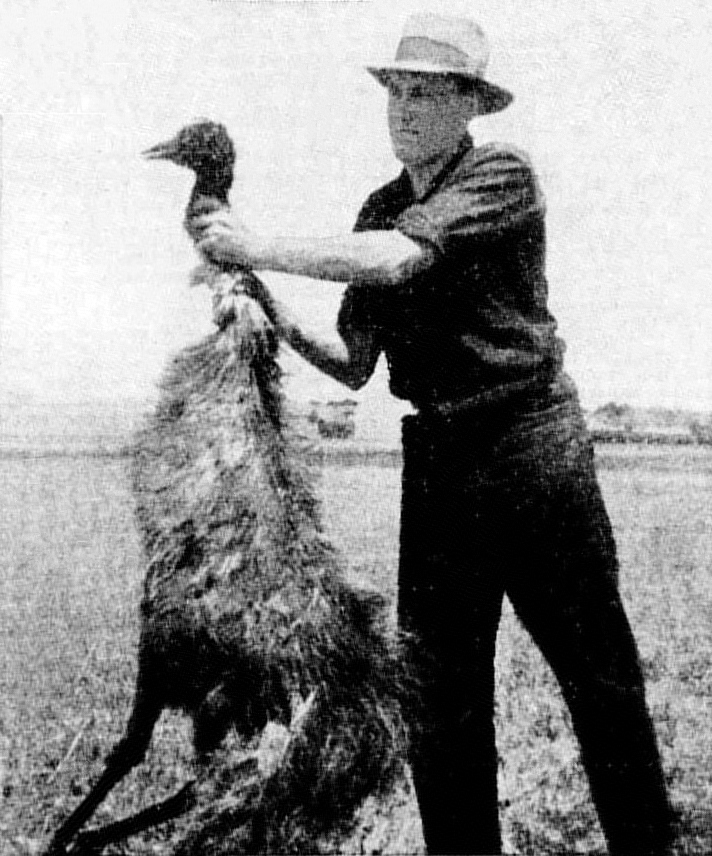
If you've been on the internet for any length of time, you've met the Great Emu War: Australia declared war on flightless birds, sent machine guns, and lost. It's told as a joke — and it is funny. But the version that circulates online is a compressed, distorted version of something that actually happened, and the real story is more interesting than the meme: a government so desperate to look like it was helping farmers that it sent a newsreel crew along, an army commander who compared birds to Zulus, and a cull that ended not because the emus were invincible but because machine-gunning them was absurdly uneconomic.
Here's what the records actually show.
The setup: a depression, marginal land, and 20,000 hungry birds
After World War I, the Australian government granted large numbers of discharged veterans land in Western Australia to farm — often in agriculturally marginal areas. When the Great Depression hit in 1929, those farmers were encouraged to grow more wheat, with the government promising subsidies it never delivered. Wheat prices kept falling; by October 1932 farmers were preparing to harvest while simultaneously threatening to refuse to deliver the crop (Wikipedia, citing Johnson 2008; The Guardian, 2023).
Into this mess came roughly 20,000 emus. Emus regularly migrate to the coast after breeding season, and the farmers' cleared land and new water supplies made superb habitat — the birds began foraying into the wheatbelt around Chandler and Walgoolan, eating and spoiling crops and wrecking the fences that kept rabbits out (Wikipedia; The Guardian, 2023).
The farmers, many of them ex-soldiers, knew exactly what they wanted: machine guns. A deputation went to the Minister of Defence, Sir George Pearce, who agreed — with conditions. Military personnel would operate the guns; the Western Australian government would fund transport; the farmers would provide food, accommodation and ammunition. Pearce also supported it on the grounds the birds would make good target practice. Some observers argued the operation was partly about being seen to help the farmers — and staving off Western Australia's secession movement. Tellingly, a cinematographer from Fox Movietone was enlisted to record it all (Wikipedia).
The "war": 1 month, 2 soldiers, 2 Lewis guns, 10,000 rounds
On 2 November 1932, Major Gwynydd Purves Wynne-Aubrey Meredith of the Royal Australian Artillery's 7th Heavy Battery, with Sergeant S. McMurray and Gunner J. O'Halloran, deployed to Campion — roughly 320 km from Perth — armed with two Lewis light machine guns and 10,000 rounds of ammunition (Wikipedia; The Guardian, 2023).
The first day set the pattern. Around 50 emus were sighted out of gun range; settlers tried to herd them into an ambush, but the birds split into small groups and ran. A second fusillade killed "a number" of birds; later, a small flock cost "perhaps a dozen" (Wikipedia). On 4 November, Meredith set up an ambush near a dam; more than 1,000 emus approached, the gunners waited for close range — and the gun jammed after 12 birds were killed, the rest scattering (Wikipedia; The Guardian, 2023).
The birds, the soldiers began to suspect, were adapting. Within days an army observer noted each pack seemed to have "its own leader now — a big black-plumed bird which stands fully six feet high and keeps watch while his mates carry out their work of destruction." Meredith even mounted a gun on a truck; the truck couldn't outrun the emus and the ride was too rough to fire. By 8 November, 2,500 rounds had been expended, with kill estimates ranging from 50 to the settlers' 200–500. Meredith's official report was witheringly deadpan: no casualties among his men "except for their dignity" (Wikipedia).
Ornithologist Dominic Serventy later summarized the military's humiliation: "The machine-gunners' dreams of point-blank fire into serried masses of Emus were soon dissipated. The Emu command had evidently ordered guerrilla tactics, and its unwieldy army soon split up into innumerable small units that made use of the military equipment uneconomic" (Wikipedia, quoting Serventy).
Meredith's own famous concession, reported at the time and repeated by The Guardian: "If we had a military division with the bullet-carrying capacity of these birds, it would face any army in the world... They can face machine guns with the invulnerability of tanks."
Round two: 986 "confirmed" kills, at 10 rounds apiece
The media mocked the operation, the House of Representatives debated it, and Pearce withdrew the soldiers on 8 November — one week in. But the emus came back, and farmers pushed again, backed by Western Australia's Premier. On 12 November the minister approved a resumption (Wikipedia).
Round two ran from 13 November to 10 December, with Meredith back in the field (the state apparently lacked experienced machine gunners). The soldiers killed roughly 40 emus in the first two days, and by early December around 100 per week. Meredith's final report claimed 986 confirmed kills from 9,860 rounds — exactly ten rounds per confirmed kill — plus 2,500 wounded birds he claimed died later. Historian Greg Beyer's verdict on that figure: "highly disputed and is likely to be very inflated" (Wikipedia, citing Beyer, The Collector, 2023).
Even the operation's supporters conceded the optics were bad. A 1935 article in the Coolgardie Miner noted the machine guns had been "criticised in many quarters" but insisted "the method proved effective and saved what remained of the wheat" (via Wikipedia).
The real lesson: bounties beat bullets
Here's the part the meme misses. After the army withdrew, the farmers' requests for military help in 1934, 1943 and 1948 were all rejected. What worked was the old-fashioned bounty system: 57,034 emu bounties were claimed in a single six-month period in 1934 (Wikipedia). Meanwhile, pest-exclusion fencing became the standard tool for keeping emus — and dingoes and rabbits — off farmland (Wikipedia, citing McKnight 1969, Geographical Review).
The "war" was abandoned not because emus are tactically brilliant but because machine-gunning them was cost-ineffective: ten rounds per confirmed kill, in a government that couldn't pay its promised wheat subsidies. The emus "won" the same way a budget deficit wins.
They also won the PR war. By December 1932 the story had reached the UK, where conservationists protested "extermination of the rare emu," and eminent ornithologists Dominic Serventy and Hubert Whittell called the operation "an attempt at the mass destruction of the birds" (Wikipedia). Emus, which stand up to 1.9 m tall, run at up to 50 km/h, and communicate by drumming, grunting and booming through an inflatable neck sac audible up to 2 km away, are Australia's actual national symbols — they're on the coat of arms (The Guardian, 2023). An army shooting them with machine guns over wheat was never going to win sympathy.
The story refuses to die
The Emu War's afterlife is arguably the point. An Australian action-comedy, The Emu War, premiered at Melbourne's Monster Fest on 22 October 2023; a rival film written by John Cleese, Rob Schneider, Monty Franklin, Camilla Cleese and Jim Jefferies has been in development since 2021 (The Guardian, 2023; via Wikipedia). In July 2026, a Reuters columnist suggested Donald Trump could learn from the Emu War before the Iran conflict — arguing it shows a technologically superior force struggles against a dispersed, determined foe (via Wikipedia).
The meme says: man declared war on bird, bird won. The reality: a struggling agricultural state, promised subsidies that never came, tried a desperate, theatrical solution to a real pest problem — and the birds outlasted the optics. It's not a story about how strong emus are. It's a story about how expensive it is to fight a dispersed enemy with a hammer.
Sources (all verified live 2026-10-21):
- Wikipedia — "Emu War" (background, first/second attempts, Meredith's report and quotes, aftermath, bounties, legacy): https://en.wikipedia.org/wiki/Emu_War
- The Guardian (Tory Shepherd, 6 Oct 2023) — "Australia's emu war: John Cleese outrun in race to shoot movie": https://www.theguardian.com/australia-news/2023/oct/06/australias-emu-war-john-cleese-outrun-in-race-to-shoot-movie-of-how-flightless-birds-thwarted-armys-machine-guns
- Photograph: Deceased emu during Emu War (public domain, via Wikimedia Commons): https://upload.wikimedia.org/wikipedia/commons/b/be/Deceased_emu_during_Emu_War.jpg
Note: secondary details (Serventy quote, Coolgardie Miner 1935, bounty totals, Meredith casualty figures) are cited via Wikipedia's article and its inline references; Wikipedia's own citations there include Johnson 2008, Trove newspaper archives, and Beyer 2023. Casualty figures are Meredith's own contested claims, flagged as such in the text.