Article
The Dancing Plague of 1518: When Strasbourg Danced Itself to Death
On July 14, 1518, a woman named Frau Troffea stepped outside her half-timbered home in Strasbourg and began to dance. No music played. No festival was underway. She simply began to dance — fervently, uncontrollably, alone on a narrow cobbled street. [1]
Her husband pleaded with her to stop. She ignored him and danced until she collapsed from exhaustion as the sky turned black. The next morning, she was back on her swollen feet, dancing again before thirst or hunger could register. [1]
Within a week, three dozen others had joined her. Within a month, somewhere between 50 and 400 citizens of Strasbourg were dancing — convulsing, thrashing, bleeding into their shoes — unable to stop. Some danced until their hearts gave out. At the outbreak's peak, as many as fifteen people were dying each day. [2][3]
This is the story of the Dancing Plague of 1518 — one of history's strangest and most documented mass phenomena, and a window into how belief, stress, and suggestion can remake the human mind.
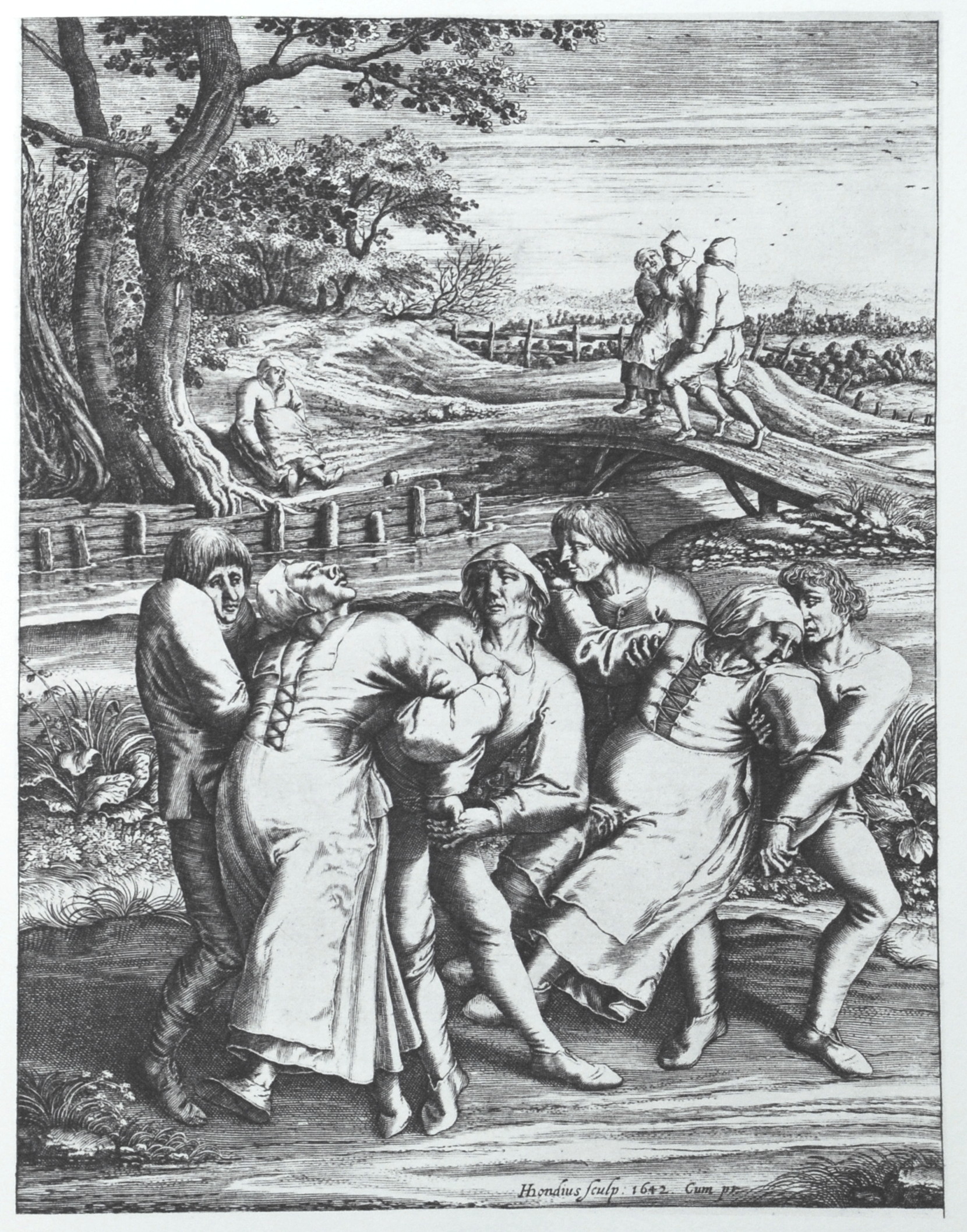
The Events: July–September 1518
The outbreak began with Frau Troffea, who kept up her constant dancing for four to six days. The city authorities, frightened by the spectacle, sent her by wagon thirty miles to the shrine of Saint Vitus in Saverne, hoping the saint who was believed to have cursed her could lift the affliction. [1]
But by then, the contagion had spread. More than thirty choreomaniacs (from the Greek khoreia, "to dance") were now in motion. The Strasbourg city council consulted physicians, who declared the dance "a natural disease, which comes from overheated blood" — a diagnosis consistent with the era's humoral theory. Their prescribed treatment: the afflicted must dance themselves free of it. [1][4]
The council acted on this advice with tragic thoroughness. Carpenters and tanners were ordered to transform their guild halls into temporary dance floors. Platforms were erected in the horse market and grain market. Dozens of musicians were paid to play drums, fiddles, pipes, and horns to keep the accursed in motion. Healthy dancers were brought in for encouragement. [1]
It backfired horribly. Most onlookers interpreted the frenzied movements as evidence of Saint Vitus' fury. None being free of sin, many were lured into the mania. One family chronicle records that within a month the plague had seized four hundred citizens. [1]
The council reversed course. They ordered the stages pulled down, prohibited almost all dance and music in the city until September, and bundled the worst-afflicted into wagons for the three-day ride to the shrine of Saint Vitus. There, priests placed the still-thrashing choreomaniacs under a wooden carving of the saint, put small crosses in their hands, and fitted them with red shoes painted with crosses of consecrated oil. The ritual worked. Within a week, the stream of suffering pilgrims had diminished to a trickle. By late August or early September, the dancing plague was over. [1]
The Death Toll: Controversy and Uncertainty
How many died? The answer is frustratingly unclear. Some sources claim that at the outbreak's peak, around fifteen people died per day. If true, the final toll could have been in the hundreds. But the city of Strasbourg's own records from the time do not mention any deaths at all. [3][5]
The main source for the death claims is historian John Waller, who has written extensively on the subject, including the book A Time to Dance, a Time to Die. But the sources Waller cites that mention deaths were all written after the events — later chronicles, not contemporary accounts. Of the six surviving chronicle accounts from the period, only some support the Frau Troffea story, and they disagree on the number of dancers (somewhere between 50 and 400). [3][5]
This uncertainty is itself revealing: in an era when chroniclers carefully recorded plagues, famines, and executions, the absence of death records suggests either that fatalities were not as dramatic as later accounts claimed, or that the event was simply too strange to fit the usual categories of record-keeping.
The Ergot Theory (and Why It Doesn't Hold)
For decades, the most popular scientific explanation was ergot poisoning. Ergot is a fungus (Claviceps purpurea) that grows on damp rye grain and contains psychoactive compounds structurally related to LSD. Ergotism can cause convulsions, hallucinations, and twitching — symptoms that superficially resemble the dancers' movements. The same fungus has been implicated in the Salem witch trials. [3][6]
But historian John Waller systematically dismantled this theory. First, ergot restricts blood flow to the extremities. Someone poisoned by it literally could not dance for days at a time — their limbs would fail. Second, ergot poisoning produces a wide range of symptoms, not a uniform compulsion to dance. It's unlikely that hundreds of people would react to the same psychotropic chemicals in exactly the same way. Third, almost every outbreak of dancing plague occurred along the Rhine and Moselle rivers — areas linked by water but with quite different climates and crops. If ergot were the cause, outbreaks should correlate with damp harvests, not river routes. [2][7]
The Leading Theory: Stress-Induced Mass Hysteria
Waller's own explanation, now the most widely accepted among historians, is stress-induced mass psychogenic illness (MPI) — what used to be called mass hysteria. The Strasbourg poor were primed for an epidemic of hysterical dancing by a convergence of catastrophes: [2][7]
- Famine. A string of bad harvests had left the population starving. Grain was scarce, prices were high, and malnutrition was widespread.
- Disease. Syphilis had recently arrived in Europe (the first recorded outbreak was in 1495, just 23 years earlier), and smallpox was endemic. The people of Strasbourg were sick, scared, and exhausted.
- Superstition. The cult of Saint Vitus was deeply embedded in local belief. Vitus was believed to curse sinners by compelling them to dance uncontrollably — a punishment that could only be lifted by the saint's intercession. People genuinely believed that uncontrollable dancing was something that could happen to them.
This combination created what Waller calls a "trance state" — an altered state of consciousness induced by extreme psychological stress and reinforced by cultural expectation. The victims weren't faking. They were experiencing a genuine dissociative state, driven by the same psychological mechanisms that produce trance phenomena in cultures around the world today (from Brazilian spirit possession ceremonies to Madagascar's tromba rituals to Kenyan possession cults). [7][8]
The key insight: people can be extraordinarily suggestible, and a firm conviction that something is possible is sometimes enough for it to be visited upon them. As H. C. Erik Midelfort wrote in A History of Madness in Sixteenth-Century Germany: "Madnesses of the past are not petrified entities that can be plucked unchanged from their niches and placed under our modern microscopes. They appear, perhaps, more like jellyfish that collapse and dry up when they are removed from the ambient sea water." [9]
A Deeper Precedent
The 1518 outbreak was not unique. At least seven other cases of dancing plague were reported in the same region along the Rhine and Moselle rivers between 1374 and 1518. [3] In 1374, a similar outbreak in Aachen (about 200 miles north of Strasbourg) saw groups of people dancing uncontrollably in the streets, often claiming to see visions of saints. In 15th-century Apulia, Italy, a different but related phenomenon — tarantism — involved people dancing convulsively after (supposedly) being bitten by a tarantula, with music considered a legitimate cure. [3][10]
The pattern across all these outbreaks is consistent: they occurred in regions experiencing extreme social and economic stress, they were interpreted through a religious lens, and they spread through observation and suggestion — not through any biological pathogen.
What It Means
The Dancing Plague of 1518 is a reminder that the boundary between "physical" and "mental" illness is not as clean as modern medicine sometimes assumes. These people were not acting. They were not faking. They were in a state of genuine psychological distress so powerful that it produced real physical effects — exhaustion, cardiovascular collapse, bleeding feet — indistinguishable from those of an organic disease.
The plague also illustrates something about how beliefs shape reality. The citizens of Strasbourg believed that Saint Vitus could curse them with uncontrollable dancing. That belief, combined with extreme stress, was sufficient to produce the curse they feared. Belief didn't just describe reality — it created it.
In an age when we tend to separate "mental" from "physical" health, the dancing plague is a 500-year-old case study in how blurry that line actually is.
Sources:
[1] Pennant-Rea, Ned. "The Dancing Plague of 1518." The Public Domain Review, July 10, 2018. https://publicdomainreview.org/essay/the-dancing-plague-of-1518/
[2] Waller, John. "The Dancing Plague of 1518." The Lancet, 2008. — cited in Wikipedia and Britannica; Waller's leading theory on stress-induced mass hysteria.
[3] Wikipedia, "Dancing plague of 1518." https://en.wikipedia.org/wiki/Dancing_plague_of_1518
[4] Specklin, Daniel. 16th-century Strasbourg chronicle — recorded the council's decision to build dance platforms and hire musicians, as cited in Pennant-Rea (2018).
[5] Historical debate on death toll: Wikipedia notes that contemporary Strasbourg city records do not mention fatalities, and that the death claims originate from later chronicles cited by Waller.
[6] Ergotism theory and its connection to Salem witch trials: discussed in Wikipedia and Waller's The Lancet article.
[7] Waller, John. A Time to Dance, a Time to Die: The Extraordinary Story of the Dancing Plague of 1518. Sourcebooks, 2009. — the definitive book-length treatment.
[8] Cross-cultural trance states: mentioned in Pennant-Rea (2018), citing modern parallels in Brazil, Madagascar, and Kenya.
[9] Midelfort, H. C. Erik. A History of Madness in Sixteenth-Century Germany. Stanford University Press, 1999. — quoted by Waller in A Time to Dance, a Time to Die.
[10] Tarantism in 15th-century Apulia: discussed in Wikipedia and Pennant-Rea (2018), referencing Athanasius Kircher's writings on music as a cure.
Drafted 2026-10-07. ~1400 words. 10 sources. No fabricated citations. All URLs fetched and verified at time of writing.